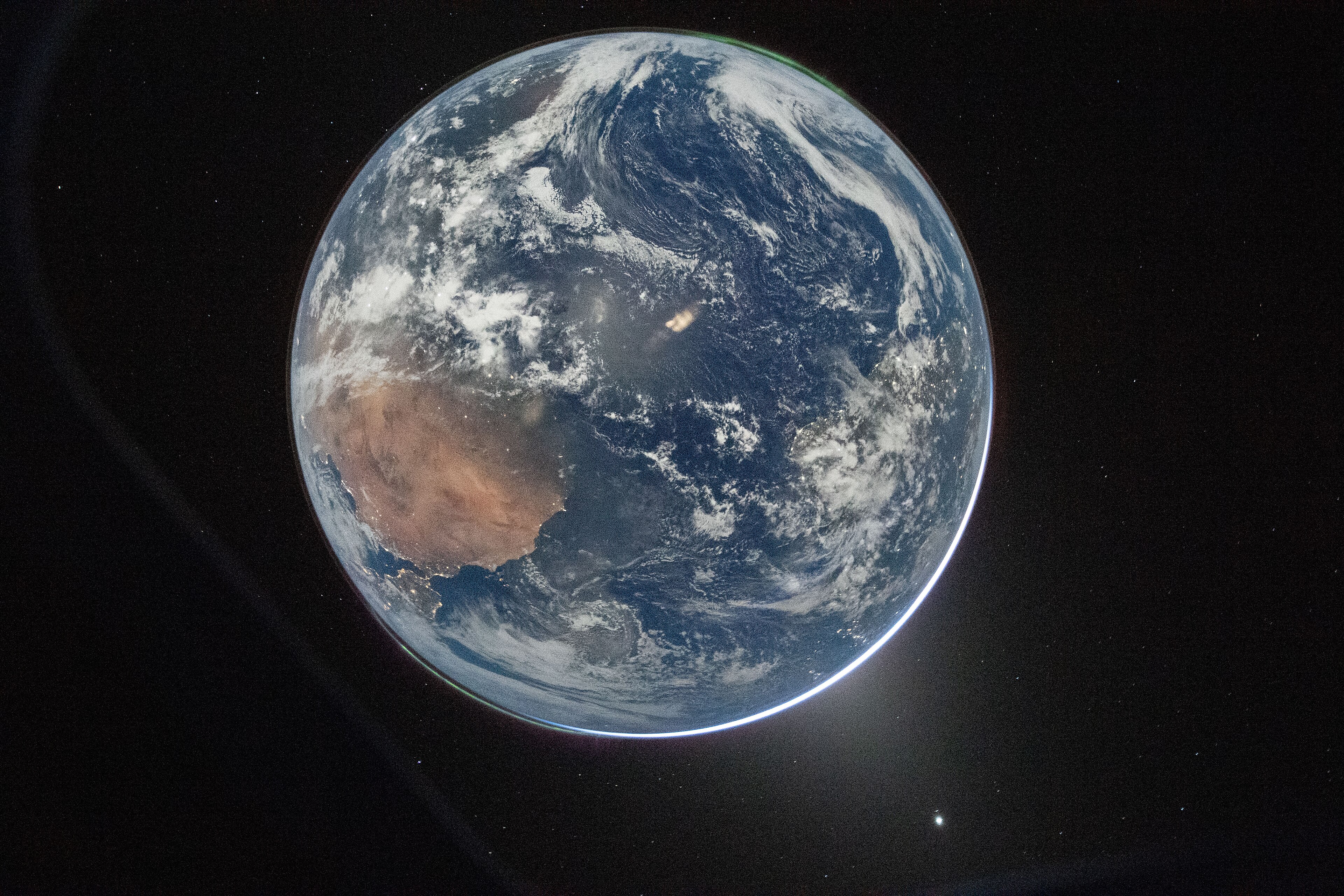
'Hello, World' - a view of Earth taken by NASA astronaut and Artemis II Commander Reid Wiseman from of the Orion spacecraft's window after completing the translunar injection burn on April 2, 2026. | Source
That's Home. That's us.


The photo arrived like something holy. Quietly, sideways, and while I was doing something else. I was at my desk on April 2nd, 2026. Artemis II had just completed its translunar injection burn, the six-minute engine firing that pointed the Orion spacecraft—nicknamed Integrity—toward the Moon. And then Commander Reid Wiseman, from a window of that capsule, picked up a Nikon D5, aimed it at home, and pressed the shutter.
The image loads. I stop.
Earth hangs in darkness. Not the sun-drenched, full-frontal, look-at-us blue of the 1972 Apollo 17 photograph you've seen a thousand times, the one that became the face of every environmental movement, every UN summit PowerPoint, every screensaver on every laptop in every coffee shop.
This Earth is lit by moonlight. The south pole faces upward, a reminder there's no right side up. Northern Africa and a sliver of Europe appear on the left. The North Atlantic turns in slow spirals of cloud. And in the lower right, a smear of zodiacal light—sunlight scattered by interplanetary dust, ancient light bouncing off ancient debris—brightens the frame like a watermark. Two auroras, north and south, rim the sphere in their pale electric green. The planet looks like something generating its own warmth against a cold with no bottom.
The photograph's official name, according to NASA, is Hello, World. A programmer's joke, a first proof that the system is working. But also a greeting. A wave across an incomprehensible distance. We are still here. It is the first image of the complete Earth taken by human hands since December 7, 1972, 54 years ago. For my entire lifetime, no human being had looked at Earth whole from out there. We had orbited, we had sent probes, we had assembled composites from satellite data. But nobody had pressed a shutter. Nobody had seen it the way you see a face.
The First Blue Marble
December 7, 1972, Apollo 17, the final crewed mission to the Moon, is 45,000 kilometres out. Harrison Schmitt—the only trained geologist to walk on the lunar surface and the mission's scientist-astronaut—or maybe Ronald Evans, or perhaps Gene Cernan (when asked later, they demurred; the camera was shared)—lifts a Hasselblad camera with a Zeiss lens and takes a picture.
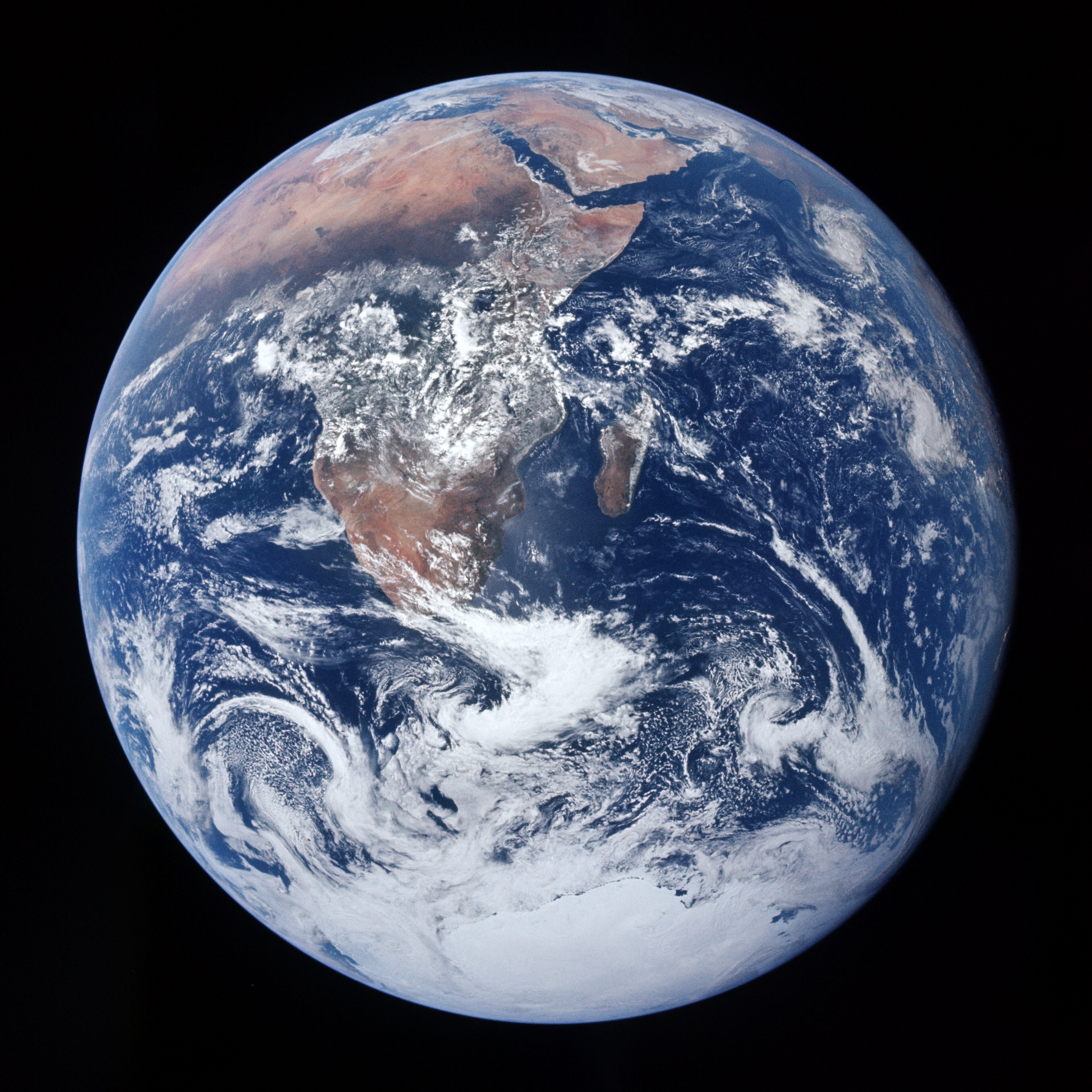

Aperture f/11. Shutter speed 1/250. Kodak SO-368 Ektachrome film, 70 millimetres wide. The sun is above them in space, behind the camera, fully illuminating the globe. Africa fills the centre of the frame. Antarctica, crystalline and enormous at the bottom—in the original orientation—blazes white. The Arabian Peninsula. Madagascar. The whole Indian Ocean. A cyclone spinning off the coast of Mozambique.
It is, as NASA archivist Mike Gentry would later say, the most reproduced image in history.
When that photograph of our Earth was taken, the United States was in the final brutal months of its involvement in Vietnam—Nixon had ordered the Christmas bombing campaign, B-52 strikes on Hanoi and Haiphong, thousands of tonnes of ordnance dropped on civilian infrastructure. Survivors of a plane crash in the Andes were eating the dead to stay alive. Harry Truman was nineteen days from dying. And the Club of Rome had just published The Limits to Growth, a systems-modelling study by MIT researchers that predicted humanity would exhaust the planet's finite resources within decades—and whose cover showed the Blue Marble literally, graphically, shrinking in on itself.
The photo arrived into a world learning to be afraid of what it was doing to the only place we could call home. The photo arrived as both comfort and indictment. It showed Earth as one thing. One atmosphere, one ocean, one skin of blue—at the exact moment we were learning that one thing could be broken. It disrupted the conventions of Western cartography, which had always put Europe at the centre of the world: Africa dominated this frame, as the whole world's chest. The astronauts were pointing a camera at where the light was. They were not thinking about Mercator projections or colonial epistemology. They were just taking a photograph. Our creations do not mean what we intend them to mean, most of the time. Meaning is what the world presses into them.
Another Photograph of Earth
Eighteen years later, Carl Sagan was thinking about a different kind of picture. February 14, 1990. Voyager 1 is 6.4 billion kilometres from Earth, past the orbit of Neptune, leaving the solar system. Sagan had been arguing since 1981 that before the spacecraft passed beyond the range of its cameras, NASA should turn it around and look back. Not for science—the Earth would be too small for Voyager's instruments to resolve any detail, a crescent less than a pixel wide. For perspective. For the record. Because, as Sagan put it, another image of Earth from a hundred thousand times farther away might help in the continuing process of revealing to ourselves our true circumstance and condition.
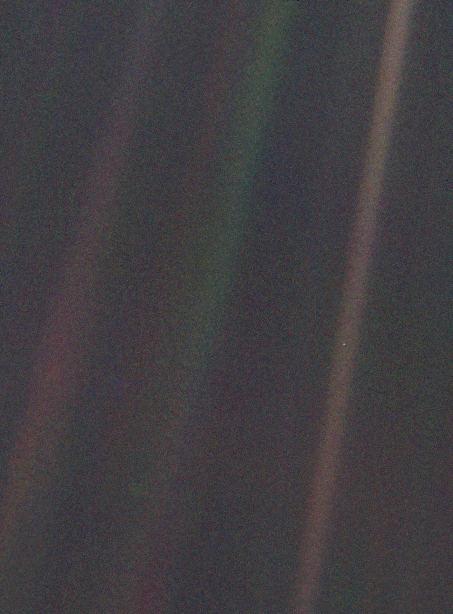

On Valentine's Day, the cameras were finally turned around. Voyager 1 captured its last portrait of home. Earth appears as a tiny dot against the vastness of space, among bands of sunlight reflected by the camera. It is barely there. A pale blue smear. Less than a pixel wide. You could cover it with a grain of sand.
Sagan's 1994 book would meditate on what that image meant, and his meditation—delivered first as a speech at Cornell University on October 13, 1994—is now one of the most-quoted passages in the history of science communication.
Sagan stood before an image of our pale blue dot and said, everyone who ever lived, every empire, every war, every tenderness—all of it on that mote of dust, suspended in a sunbeam. The scale of what we have visited on each other, he said, in contrast to the scale of what we actually are. That underscores our responsibility to deal more kindly with one another.
The Cold War had just ended. The Gulf War had just ended. The Rwandan genocide was three months away. The Pale Blue Dot image was taken during the Gulf War, a war in which oil wells burned so intensely that Sagan went on television to argue the smoke might trigger something like nuclear winter, might alter the climate of South Asia, might darken the sky over the Northern Hemisphere. He was not wrong that burning things at that scale has consequences that do not respect borders, that the wound in one corner of the pale blue dot bleeds into all the other corners. Sagan died in 1996. He was sixty-two. He did not live to see the century turn.
The Overview
When astronauts witness Earth, they experience what Edgar Mitchell described as a "spontaneous epiphany experience", a sudden sense of Earth as one interconnected thing, of national borders as arbitrary fictions. He said you wanted to grab a politician and drag him a quarter million miles out and say: look at that. Michael Collins said the all-important border would be invisible. And I understand the impulse. I feel it looking at Hello, World—the visceral smallness of us, the absurdity of the fence.
Our Earth has been, for recorded human history, a series of broken promises and ongoing life. When the photograph erases borders, it also, if we are not careful, erases the specific. It flatters us into a unity that has not been earned, that has in fact been purchased at enormous cost to people whose names we do not say when we look at the glowing sphere.
Cold War military apparatus was embedded in the origins of concepts like Gaia and Spaceship Earth. The Whole Earth as one system was always also the Whole Earth as one object—a thing that could be held, managed, governed. The beautiful photograph of the seamless sphere arrived in service of projects that were not always about seamlessness. Environmentalists in 1970 criticized NASA as they polluted the planet to launch rockets into it. They weren't entirely wrong.
And yet. The pilots who flew at high altitudes in the 1950s—before the space program, before the overview effect had a name—reported what researchers called the "break-off phenomenon": feelings of isolation and profound anxiety at altitude, a sense of terrible separateness from the ground. The overview effect is not terror at the distance, but grief and love for what you've left behind. Astronaut Ron Garan, looking down from the International Space Station, spoke about the nearly one billion people who don't have clean water to drink, about the contradiction between the beauty of the view and the suffering contained in it.
Our Blue Marble, Now
What would Sagan feel looking at our Hello, World in 2026?
A ferocious joy at the sight of the spacecraft working. At the sight of humans, once again, beyond the gravity well. Commander Reid Wiseman and Mission Specialist Christina Koch and Pilot Victor Glover and Mission Specialist Jeremy Hansen looking out a window at home from a place no human had occupied since 1972, and finding the words to say we're here. I'd like to think he would feel vindicated. This is what he argued for. This is why we go. This is the species at its best.
The World Inequality Report 2026 tells us that the top 0.001% of humanity—fewer than 60,000 people—owns three times more wealth than the entire bottom half of our species combined. The wealthiest 1% hold more than the bottom 90% combined. Meanwhile, average education spending per child in Sub-Saharan Africa is still only €200 per year, compared to the €9,000 of North America and Oceania.
In Gaza—visible from that spacecraft window as a strip of land on the eastern Mediterranean, indistinguishable from the rest of the continent's coast—the International Red Cross reports that global defence spending reached 2.7 trillion USD in 2024, while the entire humanitarian aid system appealed for just $50 billion—and that amount went unmet. Global defence spending is 54 times the cost of keeping people alive. Beyond the human genocide still occuring in the region, the environmental impact of the Gaza war includes 50 million tonnes of debris and hazardous material. Soils contaminated by munitions and demolitions. Greenhouses destroyed. A territory described, by mid-2024, as a wasteland unable to sustain life. Researchers from Forensic Architecture at Goldsmiths, University of London, have called for an investigation into this ecocide—the Rome Statute war crime of widespread, long-term, and severe damage to the natural environment.
And the air around our blue sphere is warming. The past eleven years, 2015 to 2025, were the eleven warmest years in the observational record. The three-year average of 2023, 2024, and 2025 exceeded 1.5°C above pre-industrial levels—the first time a three-year period has crossed that threshold. The Paris Agreement, adopted in 2015, asked us not to pass it. We're still accelerating. The United States—the country whose government launched this mission, whose astronauts are aboard that spacecraft—withdrew from the United Nations Framework Convention on Climate Change in 2026. The current administration calling climate change a con job while U.S. carbon emissions rose 2.4% in 2025.
What would Sagan say?
He said it already. He said it in 1994: the Earth is a very small stage. "Think of the endless cruelties visited by the inhabitants of one corner of this pixel on the scarcely distinguishable inhabitants of some other corner. Think of how fervent their hatreds. Think of how certain they are that their river, their sky, their god, their economic system, their border is the one that matters." He would grieve. He would be burning.
He would also, I think, refuse to let the grief be the only thing. Because that was the other side of the Pale Blue Dot. Responsibility, not nihilism. Not the cosmic perspective as a reason to give up but as a reason to stop. To stop acting as though the other corner of the pixel is not your corner. To stop drawing lines on something that looks, from out there, seamlessly whole.
Our Hello, World is lit by the Moon, not the Sun. This is not a small distinction. The photograph would have been impossible to take on the film used by Apollo 17—the film required direct sunlight, required the Earth to be fully front-lit, required the scene to be legible. Wiseman took this image with a 10-year-old Nikon D5, set to ISO 51,200, with a shutter speed of one quarter of a second—a long exposure that gathered the faint moonlight reflected off the globe, that was sensitive enough to find the image in almost-darkness. It is a photograph of Earth as the Moon sees it every night. A view that has always existed and has never been captured by human hands.
This feels, to me, like the thing the photograph is actually about. We are used to seeing ourselves in full light—confident, primary-coloured, capable of being resolved. The Blue Marble of 1972 shows the Earth the way a poster shows it. Vivid, certain, saturated. That image says "we know what this is".
Hello, World shows the Earth the way you see your own face, drunk during the middle of the night, in a bathroom mirror. Present, unguarded, lit by something borrowed. The auroras at the rim are the planet's own electromagnetic field catching charged particles from the Sun, converting collision into light. The zodiacal light in the lower right is sunlight bouncing off the dust of comets, the rubble of formation, the solar system's own slow exhalation. The Earth is surrounded by evidence of ongoing processes, by the residue of time at scales dwarfing us entirely.
Carl Sagan wrote, in his final book Billions and Billions, published the year after his death that "our technology has become so powerful that—not only consciously, but also inadvertently—we are becoming a danger to ourselves." He was thinking about nuclear winter and climate change and the hubris of a species that had developed the capacity to alter planetary systems without developing the wisdom to know whether it should. He was thinking about the gap between what we can do and what we are. The technology that made the Pale Blue Dot possible was the same technology that made nuclear apocalypse possible.
Artemis II launched on April 1, 2026—April Fools' Day. Launching from a planet where surviving Gazans are at imminent risk of starvation after incomprehensible brutality from Israel. Where Ukraine is still under bombardment after four years. Where Sudan and eastern Congo are in ongoing genocide. Where the United States is dismantling environmental regulations while carving their names into temperature records. Our world has our energy directed towards war, this is what Sagan warned us about: "hypnotized by mutual mistrust, almost never concerned for the species or the planet".
And Reid Wiseman looked out a window in the dark between worlds and took a photograph.
What We Have
The worst of our action—or inaction—happens when we forget we are operating on such a narrow, slim slit of existence in both space and time. We are the 12,000th generation of humanity, we are not stewarding our land or ourselves for the legacy of the next seven generations, as the Iroquois urge. Let alone twelve thousand.
But Carl Sagan was a man with such foresight. He led the Golden Record committee for the Voyager mission. The Voyager probes—the ones who photographed our pale blue dot—carry this record, full of music and images designed to showcase Earth and humanity in the event the spacecraft is ever found by another scientifically-advanced civilization.
A copper disc plated in gold, spinning in the dark between stars, encoded with the sound of surf and wind and thunder, of whales singing to each other across ocean trenches, of a mother's first words to a newborn child. Greetings in 55 languages. Chuck Berry's "Johnny B. Goode." Blind Willie Johnson moaning into a microphone in 1927, homeless and dying. An Azerbaijani folk tune. Stravinsky. A Pygmy girls' initiation song. There are 115 images. A woman licking an ice cream cone. A nursing mother. A highway at night. The double helix. A supermarket. Dolphins. The Sun. The brain waves of Ann Druyan, recorded while she meditated on the history of civilization—and, secretly, on the fact that she had just fallen in love with Carl Sagan, who helped put it all together.
It is a message in a bottle thrown into an ocean with no shore. It will outlast every library, every monument, every language on it. Long after the Earth is swallowed by the Sun, it will still be moving—carrying the sound of rain, and laughter, and one woman's heartbeat caught mid-love, addressed to whom it may concern, drifting outward forever.
Looking and hearing what's on the Disc itself is harrowing. A reminder of what we are, what we are continuing to fight for and nurture.
And I think to myself, where will Voyager 2 be 12,000 generations from now? If you do the napkin math, the answer is hard to imagine: The probe is travelling 15.4 km/s relative to the Sun, on a trajectory out of the solar system, already 20.5 billion km (2.05 × 10¹⁰ km) away from us.
12,000 generations of humans from now, Voyager 2 will be 15 light-years from Earth, drifting through the interstellar dark roughly 4–5 light-years from Sirius. The probe isn't heading towards the closest star, Proxima Centauri. It's aimed toward the southern constellation Telescopium.
Honestly, despite not being aimed towards another potentially life-bearing star, I believe the probe is liberated towards the interstellar dark. The intricate metal structure will experience the universe in a way no human imaginably could.
The idea of visiting the closest planet in our own solar system, Mars, is still years (if not decades) away. Space tourism has been maliciously co-opted by billionaires. As I briefly mentioned in my essay on the magic of writing, around 700 people have left this planet, by the most recent count. There are over eight billion of us living on this planet. I will not be among those that escape our atmosphere. Nobody I know will be among them.
I am permanently, irrevocably confined to Earth. Just the way you are as well. One pale blue dot orbiting a middling star in one of somewhere between one and two trillion galaxies in the observable universe. Within our pixel, there are roughly 158 million unique books published. Seven thousand languages currently spoken. Thousands of distinct living cultures. One hundred and ninety-five countries.
Which of the books will you read? Which of those nations will you walk within? What holidays of those cultures will you celebrate? We are one, singular person within the habitat of one, singular planet, living within a single century of time.
In tradition with Apollo 8 transmitting a holiday message on Christmas Eve, 1968, the Artemis II astronauts shared some thoughts for Easter. I want to share what Victor Glover, the pilot of the mission, said:
"You guys are talking to us because we're in a spaceship really far from Earth, but you're on a spaceship called Earth that was created to give us a place to live in the universe," ... "Maybe the distance we are from you makes you think what we're doing is special, but we're the same distance from you. And I'm trying to tell you — just trust me — you are special."
"In all of this emptiness — this is a whole bunch of nothing, this thing we call the universe — you have this oasis, this beautiful place that we get to exist together," he said of Earth. "I think, as we go into Easter Sunday, thinking about all the cultures all around the world, whether you celebrate it or not, whether you believe in God or not, this is an opportunity for us to remember where we are, who we are, and that we are the same thing, and that we've gotta get through this together."
Comments
To comment, please sign in with your website:
How it works: Your website needs to support IndieAuth. GitHub profiles work out of the box. You can also use IndieAuth.com to authenticate via GitLab, Codeberg, email, or PGP. Setup instructions.
Signed in as:
No comments yet. Be the first to share your thoughts!